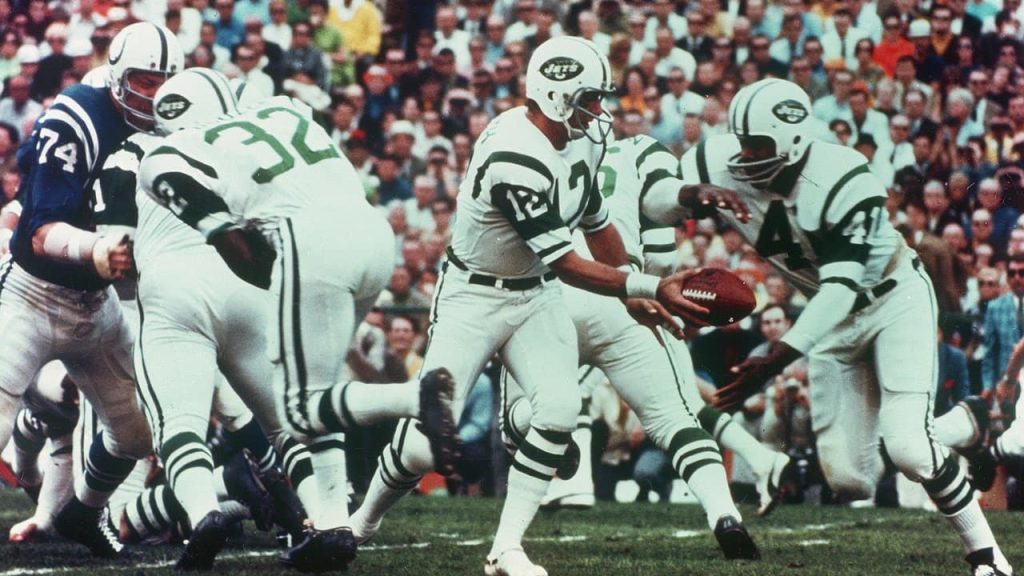


Very few football experts in January of 1969 thought the Jets could be competitive against Baltimore
On January 11th, 1969, the thinking about the nearly officially named Super Bowl was this: Baltimore was going to beat the New York Jets and the game would not be close. The National Football League would continue to show its superiority in the biggest game of them all, the Super Bowl. In 1967, Vince Lombardi’s Green Bay Packers easily beat the American Football League’s Kansas City and in 1968, Lombardi’s Packers defeated the American Football League’s Oakland Raiders. Of course, what was omitted in that thinking was that Lombardi’s Packers beat almost everyone and won NFL Championships in 1961, 1962, 1965, 1966 and 1967.
The AFL’s New York Jets-NFL’s Baltimore Colts game was the turning point in the popularity of the Super Bowl. The National Football League and most of the football media thought the old league would just be better all the time and that dominance was going to carry on well into the 1970s. There was a thought that somehow the NFL needed to come up with a new formula so that just NFL teams would appear in the Super Bowl. That would make the game more competitive and appealing.
The New York Jets franchise led by the owner Sonny Werblin was the free spending rebels from the rebel league although Werblin was gone as one of the Jets organization’s owners in 1968. New York quarterback Joe Namath had a large contract, wore long hair and played in white shoes. The Colts quarterbacks, Earl Morrall and Johnny Unitas both had crew cuts. Namath was known as Broadway Joe, a nickname given to him by former Colt and Jet offensive lineman Sherman Plunkett. Unitas was known as Johnny U and wore black high-top shoes.
Namath had a public perception of being a playboy who enjoyed New York life to its fullest and was a braggart. Unitas had little to say.
While the Jets coach Weeb Ewbank was studying films of the Colts and analyzing why the Chiefs and Raiders lost, Namath was talking and was ahead of his time as a trash talk pioneer. Except Namath only said two things and was probably only echoing what his coaching staff and teammates were thinking.
Namath said there were four quarterbacks in the AFL who were better than Morrall, the Colts starter and then said, “We are going to win this game. I guarantee it.”
Ewbank had to convince his Jets to keep quiet and play football and not say a thing about beating Baltimore. He was in one way seeking NFL respect but in another way laughing at the Super Bowl. Weeb knew his Jets could win and the AFL was a quality league.
“They weren’t giving the AFL anything,” he said years later. “I thought there were two great teams in Super Bowl I and II. They were fine ball clubs. I don’t think there has ever been much better material than they had at Kansas City. They had great athletes and the Raiders were a good football team.
“In both games, they let themselves get upset. In the first game, they had an interception in the third quarter and the Chiefs weren’t any good in the ballgame after that after Green Bay scored. Then the Raider game, they had a dropped punt and a recovery and then they weren’t in the game anymore.
“When we went into out game, we said no matter what happened, we weren’t going to let it upset us. Whether it be an official call, an interception, a fumble or what. Why we weren’t going to let that upset us. We were going to stick to the game plan.”
But one thing Ewbank didn’t count on was Namath sounding more like Muhammad Ali than the average football player.
Ewbank brought the Jets to Fort Lauderdale to work out prior to the game. The Jets stayed at the Galt Ocean Mile Hotel where Namath was given the same room that Vince Lombardi used the year before. The Jets trained at the New York Yankees Fort Lauderdale spring training complex and he was given Mickey Mantle’s locker. Twists of fate?
Maybe, but Namath broke the athlete’s code. He guaranteed a win. Ewbank was not amused.
“We had gone down there as 17 points underdogs which I liked,” he recalled. “I told the guys don’t pay any attention to what I say because I want to try to make it 21 if I can. Don’t you guys do anything to stir them up. Well, I could have shot Joe when he said that.”
But Namath and the Jets were confident and really believed they were better than the Colts.
“That’s true and I understood Coach Ewbank,” said Namath. “The next day I saw Coach Ewbank and he said my goodness these guys (the Colts) are overconfident and I have been working on that and here you are giving them fuel to get fired up for the game.
“I simply said, Coach if they need clippings to fire them up, then they are in trouble. That was that. He made me aware that he was very upset that I had said what I did and I felt badly about it after that. Fortunately we won.”
The Jets did go out and won 16-7. The AFL had arrived nearly 10 years after Hunt and Bud Adams decided to go ahead with their plan.
The Jets apparently didn’t think too highly of the Tiffany Trophy the organization received for winning the game. The team left it behind in Miami’s Orange Bowl in a backroom and returned to New York.
“The important thing was we won,” said Namath.
Namath, Ewbank and the rest of the Jets permanently etched the term Super Bowl into the American mindset. Namath, the quarterback, became a TV host, sex symbol, rebel, hero and salesman. The Jets victory that day might have been crushing for old line NFL owners and the sports media that fawned over the NFL, but NFL Commissioner Pete Rozelle saw a silver lining. In the NFL Publication, The Super Bowl, Celebrating a Quarter of a Century of America’s Greatest Game, Rozelle admitted the Jets’ upset that day mushroomed interest in football.
An excerpt from the book “America’s Passion: How a Coal Miner’s Game Became the NFL in the 20th Century”.