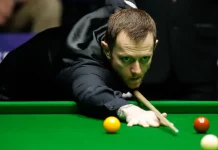



Twenty years on from his final Masters appearance, and almost two decades after his death, it’s not the trophy that bears his name that keeps Paul Hunter’s legacy alive
Paul Hunter arrived in snooker clearly cut from a different cloth. With his distinctive hair and quiet sense of style, he stood apart in a sport defined by a more conservative style. While others moved through the game with steady precision, Hunter carried a presence that suggested the game might just bend to him – that behind the measured shots there was rhythm, confidence, and an unmistakable individuality.
But Hunter was more than style and presence. Behind the flair lay a player determined to be the best in his own way. Not even six months into his professional career, he had reached a ranking semi-final at just 17, at the Welsh Open. Two years later, he would claim the very same title, producing a nerveless dismantling of John Higgins in the final – a remarkable feat considering Higgins would go on to win his first world title just over three months later.
But despite all this early success, and the admiration it earned from fellow players, pundits, and fans alike, it was at the Masters that the precocious Yorkshireman would truly cement his legacy.
When the Masters was his: Hunter and four years of dominance
Like most players, Hunter longed for a world championship title. He never quite reached it, cruelly undone by Ken Doherty in the 2003 semi-final when two frames from the final, having led 15–9. But if the Crucible remained just out of reach, it was at the Masters that Hunter found his true Triple Crown authority.
From 2001 to 2004, he won three titles and reached a further semi-final. Even more remarkable was the manner of those victories, with each title secured in a deciding frame after overturning significant deficits.
2001 Final: Hunter 10 – 9 Fergal O’Brien
In 2001, he trailed 6–2 after the opening session of the final, played in a first-to-10-frames format. When play resumed in the evening, Hunter produced a remarkable turnaround, compiling four century breaks on his way to victory in a deciding frame. The achievement gained an extra layer of notoriety when Hunter later revealed that, in an effort to relieve tension between sessions, he had briefly escaped to unwind with his then girlfriend.
After the victory, Hunter spoke to the press, describing the unorthodox method – one he jokingly referred to as “Plan B.”
“Sex was the last thing on my mind. I just wasn’t in the mood. But I had to do something to break the tension. It was a quick session – around 10 minutes or so – but I felt great afterwards. She jumped in the bath, I had a kip and then played like a dream. I reeled off four centuries in six frames. I won easily.”
2002 Final: Hunter 10 – 9 Mark Williams
The following year, Hunter returned as top seed but again had to go through the mill to reach a second successive final, edging through both his quarter-final and semi-final in deciding frames before facing Welsh firebrand Mark Williams in the championship match.
If the 2001 final had offered little margin for error, this one was even more unforgiving. He fell behind 5–0 but refused to let the match go, halting the slide by taking the sixth frame before digging in as the contest became scrappy. From there, he fought back to level matters and close it out, becoming only the third player to win back-to-back Masters titles.
2004 Final: Hunter 10 – 9 Ronnie O’Sullivan
After falling at the semi-final stage in 2003, Hunter returned to the final once more, this time facing Ronnie O’Sullivan, who had one Masters title at the time but has since gone on to hold the outright record with eight.
Any hope of an easier passage to victory was short-lived as O’Sullivan burst out of the blocks, leaving Hunter reeling. He ended the first session 6–2 behind once again, with the eight frames taking just under 100 minutes to complete.
Hunter’s ability to turn potential scar tissue into triumphs again served him well as he stayed strong despite trailing 2–7, 6–8 and then 7–9. He responded with a stunning 100 clearance, his fifth century of the final, and it proved the catalyst as he took the last two frames to become a three-time Masters champion.
Final Masters bow and the tragedy that led to a lasting legacy
Just a year after his final Masters title, Hunter was diagnosed with malignant neuroendocrine tumours and began chemotherapy. He competed at the 2006 Masters, which would prove to be his final appearance at the tournament, but lost 6–3 to Mark Williams in the first round.
His final professional match came in a first-round defeat to Neil Robertson at the World Snooker Championship in 2006. Admitting that he was in constant pain, Hunter chose to sit out the 2006–07 season to focus fully on treatment.
Sadly, he lost his battle with cancer and died on October 9, 2006, just days short of his 28th birthday.
It was a tragic loss to the sport, and players soon called for the Masters trophy to be renamed in his honour. In a widely criticised delay, World Snooker Tour did not make the change until 2017, when it was finally renamed the Paul Hunter Trophy.
But Hunter never needed his name on the trophy to be remembered. His affable nature, obvious talent and flair for dramatic comebacks had already etched his name into the minds of players and fans alike. It was a legacy built on brilliance and, though all too brief, one that will endure.